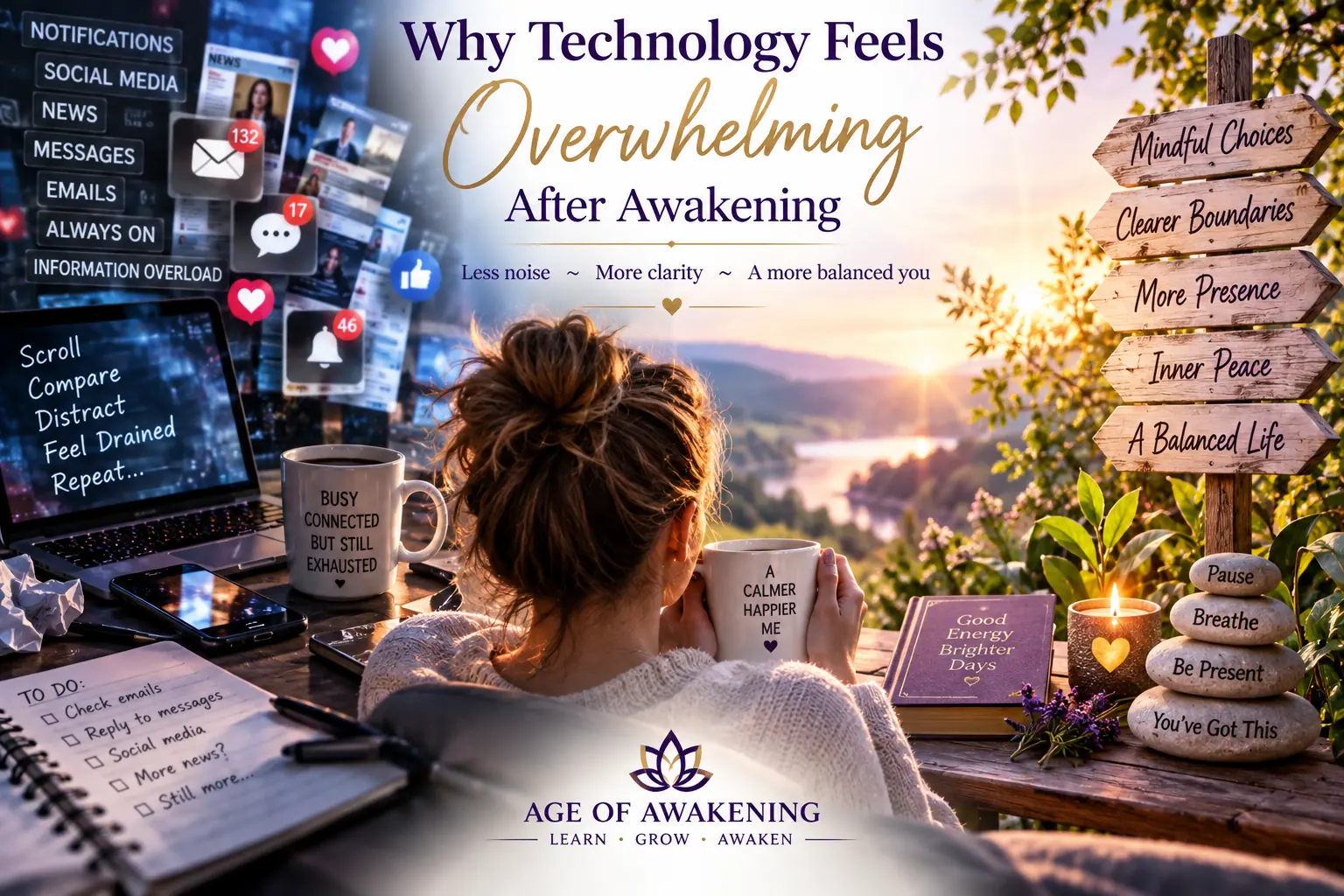
Why Technology Feels Overwhelming After Awakening
Have you ever picked up your phone and suddenly thought:
I just can’t deal with all this noise today.
The notifications.
Messages.
Social media.
News.
Videos automatically playing.
People constantly wanting your attention.
Sometimes nothing about the technology itself has changed, yet your relationship with it suddenly feels completely different.
I’ve spoken before about how periods of spiritual and personal change can make us question things we previously accepted without thinking about them. Technology can become part of that.
Some people going through what they describe as a spiritual awakening tell me they want more quiet, more nature, fewer distractions and much less time online.
That doesn’t necessarily mean your spiritual awakening has suddenly made you “sensitive to technology”.
There may be something much simpler happening.
Perhaps you’re becoming more aware of what takes your energy and what gives something back.
And once you notice that difference, it can be very difficult to ignore.
If you’re still trying to understand what you’re experiencing, you may find my guide to what a spiritual awakening is helpful alongside this article.
Why Can Technology Suddenly Feel Like Too Much?
Think about how much information reaches you through one small phone.
Messages.
Emails.
News.
Videos.
Advertising.
Social media.
Opinions.
Photographs.
Work.
Family conversations.
Notifications.
All of it can arrive within minutes.
Most of us become so accustomed to this that we barely notice how often our attention is being interrupted.
But during a period of personal or spiritual change, you may begin noticing things you previously ignored.
You might suddenly realise how often you’re checking your phone.
Perhaps certain social-media accounts leave you feeling drained.
Maybe watching the news before bed no longer feels good.
Or you may simply find yourself craving silence.
That doesn’t mean there’s anything wrong with you.
It may simply mean you’re becoming more conscious of where your attention is going.
Spiritual Awakening Can Change What You Want From Your Time
One of the things people often describe during spiritual awakening is a change in priorities.
Things that once felt important may suddenly feel less important.
You might become more interested in:
- Quiet
- Nature
- Reflection
- Meaningful conversations
- Meditation
- Creativity
- Personal development
- Spirituality
- Spending time alone
- Being more present
At the same time, constant scrolling can begin to feel strangely empty.
You may look at something you’ve spent hours doing for years and suddenly think:
Why am I giving so much of my life to this?
That can feel uncomfortable.
But questioning an old habit doesn’t automatically mean the habit was terrible.
It may simply mean you are changing.
If you’re noticing other changes too, my article on spiritual awakening symptoms explores some of the experiences people commonly associate with periods of spiritual change.
When Your Attention Starts to Feel Different
There is another side to this that isn’t particularly mystical.
Modern technology is very good at competing for our attention.
A notification appears.
You check it.
While you’re there, you see something else.
Then another thing.
Before you know it, the reason you originally picked up your phone has disappeared completely.
When you’re already tired, emotionally stretched or doing a lot of inner reflection, that constant switching can simply feel like too much input.
You may find yourself thinking:
I need everybody to stop talking to me for a while.
The last thing I want is another screen in front of me.
More than anything, I just need some quiet.
Sometimes that’s all it is.
Your mind is asking for a break.
And I think it’s important that we listen to that without immediately turning every experience into a spiritual sign.
Why Social Media May Feel Different During Spiritual Awakening
Social media can become particularly noticeable during periods of change.
Perhaps you begin questioning why you’re following certain people.
Maybe you notice how often you’re comparing your life with somebody else’s.
You may become more aware of arguments, negativity or content designed to keep you scrolling.
Or perhaps you simply realise that you’ve been consuming far more than you’ve been consciously choosing.
I’ve always believed that spiritual development should help us become more aware of our choices, not frightened of the world around us.
So rather than deciding social media is “bad energy”, I think a more useful question is:
How do I feel after spending time here?
Do you feel inspired?
Connected?
Informed?
Entertained?
Or do you usually put your phone down feeling irritated, inadequate, anxious or exhausted?
That answer tells you something useful.
Wanting More Nature and Less Noise
During periods of spiritual development, many people find themselves drawn towards simpler environments.
Nature.
Walking.
Gardening.
The sea.
Trees.
Animals.
Quiet rooms.
Sometimes people interpret this entirely spiritually, but I think there’s another way to look at it too.
Nature asks very little of us.
A tree doesn’t send you a notification.
The sea doesn’t ask you to reply.
A bird doesn’t care whether you’ve seen its latest post.
You can simply be there.
And when your mind has been surrounded by information all day, that can feel incredibly refreshing.
Nature can also become part of a simple daily spiritual practice without needing to turn it into anything elaborate.
Sometimes a walk really can just be a walk.
Are You Becoming More Sensitive — or Simply More Aware?
This is where I think language matters.
You may hear people say that spiritual awakening makes you more sensitive to technology, Wi-Fi, frequencies or electrical devices.
I would be careful about assuming that.
There isn’t good evidence that spiritual awakening causes a physical sensitivity to ordinary technology.
However, you can become more aware of how your environment affects you.
Perhaps bright screens bother you more when you’re tired.
Constant notifications may feel intrusive.
Too much news might leave you emotionally overloaded.
Scrolling late at night may make it harder for you to switch off.
Those are real experiences without needing to give them a supernatural explanation.
Sometimes awareness itself changes the experience.
Once you notice how noisy something feels, it’s difficult to stop noticing it.
What About Schumann Resonance?
You may have come across claims connecting spiritual awakening, technology sensitivity and the Schumann resonances.
Schumann resonances are real electromagnetic resonances associated with the space between Earth’s surface and the ionosphere.
However, that doesn’t mean changes in them have been shown to cause spiritual awakening or make people suddenly intolerant of phones, computers or Wi-Fi.
Those are much bigger claims.
I think we can remain spiritually curious without presenting every interesting theory as established fact.
For me, spirituality doesn’t become weaker when we say:
I don’t know.
Sometimes that’s the most truthful answer we have.
Is It Spiritual Awakening or Digital Overload?
It could be tempting to attribute everything you’re experiencing to awakening.
But ask yourself what else is happening in your life.
Have you been working long hours?
Are you sleeping properly?
Are you spending hours on your phone?
Have you been dealing with stress?
Are you constantly available to everybody?
Are you consuming upsetting news?
Do you ever have periods when nobody can contact you?
Sometimes what feels like spiritual sensitivity may simply be overload.
And recognising that gives you practical options.
You don’t have to solve an enormous spiritual mystery.
You might simply need a quieter evening.
When Not to Assume It’s Spiritual Awakening
I think this deserves its own section.
Not every difficult physical or emotional experience is a spiritual-awakening symptom.
If you’re experiencing persistent headaches, visual disturbances, severe anxiety, panic, ongoing insomnia, extreme fatigue, dizziness, significant changes in mood or anything else that concerns you, don’t automatically assume spirituality is the explanation.
Talk to an appropriate healthcare professional.
You can explore spirituality and look after your physical and mental health.
The two aren’t enemies.
I’ve written more about this balance in my guide to dealing with anxiety during spiritual awakening.
Spiritual explanations should never stop us seeking practical support when we need it.
How to Make Technology Feel Less Overwhelming
You don’t have to throw away your phone and disappear into the mountains.
Technology is part of modern life, and it can be incredibly useful.
The aim is simply to become more intentional about how you’re using it.
A few small changes can make a big difference to how your day feels.
Turn Off Notifications You Don’t Need
Not every app deserves immediate access to your attention.
Go through your notifications and ask:
Do I genuinely need this application interrupting me?
If not, switch it off.
You can still open the app when you choose.
That small distinction gives some control back to you.
Stop Taking Your Phone Everywhere
You don’t have to carry your phone from room to room.
Try leaving it somewhere else while you eat.
Take a shower without it sitting beside you.
Make a cup of tea and don’t bring it.
Go into the garden for ten minutes without it.
These sound like tiny things.
That’s because they are.
But small habits can begin changing your relationship with technology.
Create a Screen-Free Beginning to Your Day
Many of us reach for our phones almost immediately after waking.
Before we’ve even checked in with ourselves, we’re checking in with everybody else.
Try giving yourself ten or fifteen minutes first.
Open the curtains.
Have a drink.
Stretch.
Write in your journal.
Sit quietly.
Set an intention.
You might use some of the ideas in my guide to simple spiritual rituals to create a morning routine that feels more intentional.
The world can wait a few minutes.
Be More Selective About What You Consume
Not everything deserves your attention simply because an algorithm puts it in front of you.
Unfollow accounts that consistently leave you feeling worse.
Mute conversations when you need space.
Choose when you read the news rather than checking it constantly.
Be selective about the spiritual content you consume too.
You don’t need fifty people every day telling you what the universe is supposedly trying to tell you.
Sometimes that creates more confusion rather than clarity.
Give yourself room to hear your own thoughts.
Take Proper Breaks From Screens
Scrolling from your work computer to your phone isn’t really a screen break.
Neither is watching television while checking social media.
Give your eyes and attention something genuinely different.
Look outside.
Make something.
Cook.
Read a physical book.
Speak to somebody.
Sit in the garden.
Walk.
Stroke the dog.
Do something ordinary.
Grounding doesn’t always need to look spiritual.
Often the ordinary things are the most grounding of all.
Create a Technology Boundary in the Evening
If you find technology particularly overwhelming at night, create a point where the day begins to quieten.
It doesn’t have to be an extreme digital detox.
Perhaps you stop answering work emails after a certain time.
Maybe social media goes off an hour before bed.
You could leave your phone away from the bed.
Or replace twenty minutes of scrolling with reading, journalling or quiet reflection.
A boundary only works if it’s realistic.
Choose something you can actually maintain.
Use Technology for Your Spiritual Development — Without Living on It
Technology isn’t automatically opposed to spirituality.
You’re reading this article through technology.
Online courses can make spiritual education accessible.
Guided meditations can be incredibly useful.
You can listen to music, learn, connect with people and discover ideas you may never have encountered otherwise.
The problem isn’t simply technology.
It’s when we stop choosing how we use it.
If you’re studying spirituality online, decide when you’re learning and when you’re simply consuming.
There’s a difference.
My guide to online psychic development classes versus in-person training explores this from a learning perspective too.
Ground Yourself in the Real World
If your spiritual development starts to feel overwhelming, come back to ordinary life.
Eat.
Sleep.
Walk.
Talk to people.
Clean the kitchen.
Spend time with your family.
Go outside.
Laugh.
Do something completely unrelated to spirituality.
I think this is incredibly important.
Spiritual awakening shouldn’t mean becoming disconnected from everyday life.
For me, healthy spiritual development should help you become more present within your life, not less.
If you’re struggling to find that balance, my guide on how to navigate a spiritual awakening goes into this in more detail.
You Don’t Have to Be Available All the Time
Technology has created an expectation that because somebody can contact us immediately, we should respond immediately.
You don’t have to.
A message isn’t always an emergency.
Neither is an email.
You are allowed to finish what you’re doing before responding. It’s also okay to have quiet time, put your phone down and protect periods of your day when nobody else has immediate access to your attention.
After all, being contactable doesn’t mean you have to be constantly available.
That isn’t selfish. It’s a boundary.
What If You Work With Technology All Day?
Not everybody can dramatically reduce screen time.
If your job involves a computer, telling you to “spend less time online” isn’t particularly helpful.
Instead, focus on what you can control.
Take genuine breaks where possible.
Look away from the screen regularly.
Turn off unnecessary notifications.
Keep recreational scrolling separate from work.
Spend some of your free time doing things that don’t involve another screen.
And don’t expect yourself to have the same tolerance for digital entertainment after spending eight hours working on a computer.
Sometimes your brain has simply had enough screens for one day.
Finding Your Own Balance
There isn’t a perfect amount of technology everybody should use.
Your life isn’t somebody else’s, so the balance that works for another person may not work for you. Your responsibilities, work and tolerance for screen time will all be different.
Therefore, rather than following somebody else’s rules, pay attention to what works within your own life.
And your relationship with technology may change over time.
What matters is noticing.
If something consistently leaves you feeling depleted, ask whether you can change how you’re engaging with it.
If technology helps you learn, connect or create, enjoy that too.
This isn’t about declaring the digital world bad and the natural world good.
It’s about becoming more conscious of what supports you and what overwhelms you.
Final Thoughts
If technology suddenly feels overwhelming during a period of spiritual awakening or personal change, you don’t have to assume something strange is happening to you.
Perhaps you’re simply noticing more.
Maybe you’re craving quiet.
Perhaps your priorities are changing.
Or you may simply be overloaded and need a break.
Whatever the reason, you don’t have to reject technology completely.
Use it intentionally.
Create boundaries.
Spend time away from screens.
Reconnect with ordinary life.
And pay attention to how different environments make you feel.
Spiritual growth doesn’t require you to escape the modern world.
For me, it’s about learning how to live within it without losing your connection to yourself.
Frequently Asked Questions
Why does technology feel overwhelming during spiritual awakening?
Some people report wanting less stimulation, noise and screen time during periods they describe as spiritual awakening. However, digital overload, stress, tiredness, constant notifications and changing priorities can also contribute. Spiritual awakening hasn’t been established as a direct cause of technology sensitivity.
Can spiritual awakening make you physically sensitive to Wi-Fi or electronics?
There isn’t good evidence that spiritual awakening causes physical sensitivity to Wi-Fi or ordinary electronic devices. If you’re experiencing persistent physical symptoms, don’t assume they are spiritual; seek appropriate medical advice where needed.
Should I stop using technology during spiritual awakening?
Not necessarily. Technology can be useful for work, communication, learning and spiritual development. Creating boundaries and taking regular screen-free periods may be more practical than trying to avoid technology completely.
Is digital overwhelm the same as spiritual awakening?
No. Digital overwhelm can happen to anyone. During a period of personal or spiritual change, however, you may become more aware of habits or environments that no longer feel comfortable.
How can I feel more grounded when technology becomes overwhelming?
Try stepping away from screens, spending time outdoors, reducing unnecessary notifications, doing ordinary physical activities, resting and creating periods when you’re not immediately available online.
Is Schumann resonance responsible for technology sensitivity during spiritual awakening?
Schumann resonances are real natural electromagnetic phenomena, but claims that they cause spiritual awakening or technology sensitivity haven’t been established. It’s reasonable to remain curious while distinguishing spiritual interpretations from evidence.
Age of Awakening Ltd, Company No. 16072576
Copyright © 2026 All Rights Reserved

You may also like

7 Signs You May Be Walking on Eggshells in a Relationship

Understanding Tarot Card Readings