

-
×
 AMETHYST NECKLACE & EARRINGS GIFT SET
1 × £6.95
AMETHYST NECKLACE & EARRINGS GIFT SET
1 × £6.95
Subtotal: £6.95
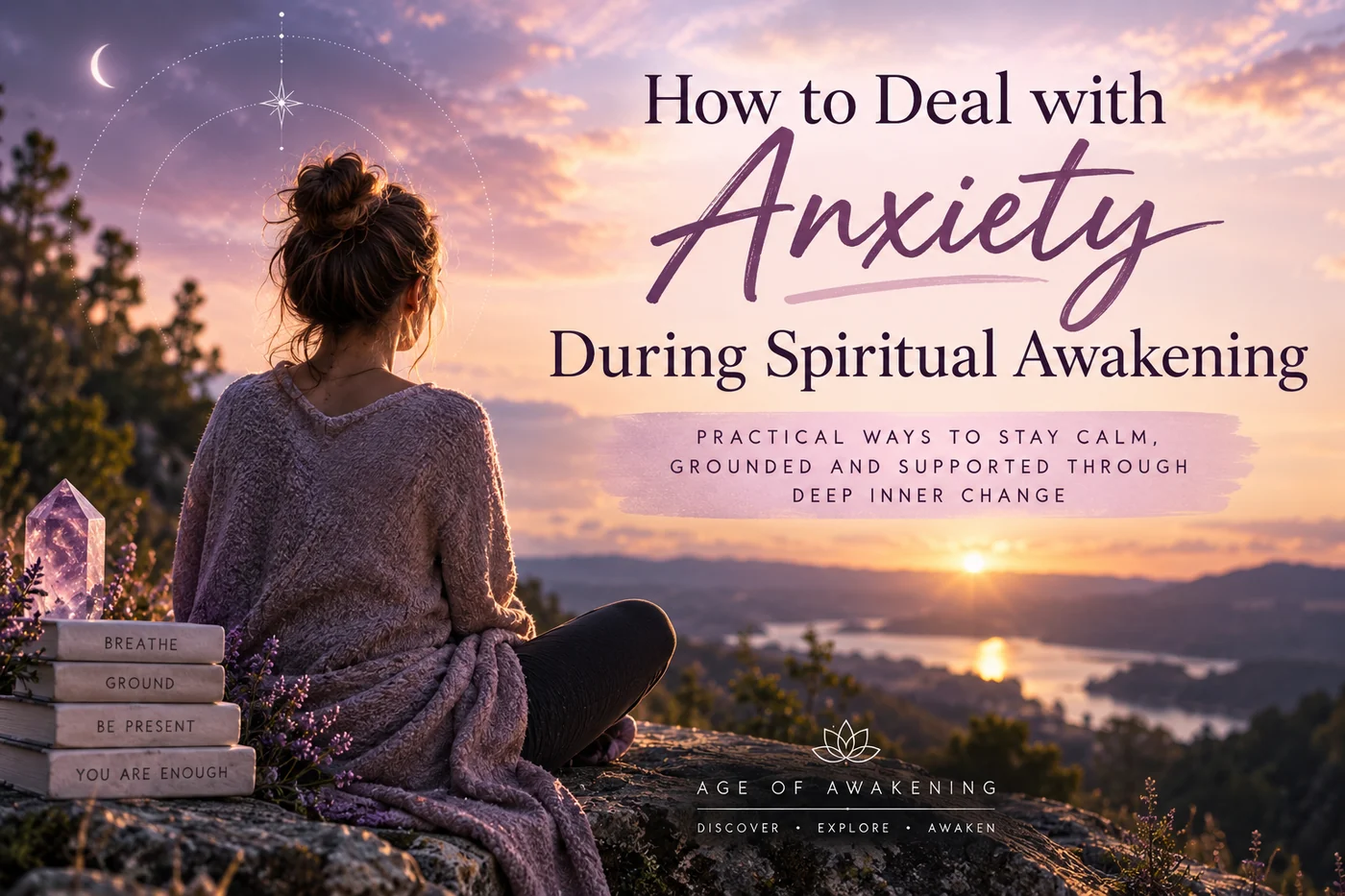
If you are experiencing anxiety during a spiritual awakening, you may be wondering why something that is supposed to bring greater awareness can sometimes feel so unsettling.
Spiritual awakening isn’t always a peaceful or blissful experience. Sometimes it can feel confusing. You may begin questioning things you once accepted without a second thought. Your priorities may change, certain relationships may feel different, and you may find yourself looking at your life — and yourself — in a completely new way.
When so much is changing internally, it is understandable that you may sometimes feel anxious, overwhelmed or uncertain.
I always believe that spirituality should help us become more grounded in ourselves and in our lives, not frightened of what we are experiencing. So if things begin to feel overwhelming, you don’t have to understand everything at once.
Sometimes the most spiritual thing you can do is simply come back to yourself, put your feet on the ground, breathe and take things one day at a time.
A spiritual awakening can encourage you to look beneath the surface of your life.
You may begin questioning old beliefs, noticing patterns in your behaviour or relationships, becoming more aware of your intuition, or realising that some aspects of your life no longer feel right for you.
That can be incredibly freeing, but change can also create uncertainty.
We often feel safest with what is familiar — even when the familiar isn’t necessarily what is best for us. When our understanding of ourselves begins to change, the mind can naturally look for certainty.
You may find yourself asking:
Why am I feeling like this?
Why do I suddenly see things differently?
What is happening to me?
Where is all of this leading?
Not having immediate answers can feel uncomfortable.
This is why I encourage people going through a spiritual awakening to remain grounded while they explore what their experiences mean to them.
You don’t need to have all the answers today.
There isn’t one set of experiences that everyone goes through during a spiritual awakening. We are all individuals, and our spiritual journeys can unfold very differently.
However, you may notice things such as:
You may also recognise some of the experiences I discuss in my article about the signs of a spiritual awakening.
But it is equally important to remember that not every uncomfortable physical or emotional experience has a spiritual explanation.
Anxiety can arise for many reasons, and spirituality shouldn’t prevent us from looking after our emotional, physical and mental wellbeing.
When your thoughts are racing, it can be tempting to keep searching for answers.
You might read another article, watch another video, pull another tarot card or ask yourself repeatedly what the Universe is trying to tell you.
Sometimes that simply adds more noise.
Before looking for another explanation, bring yourself back into the present moment.
Try something simple.
Put both feet firmly on the floor and notice the sensation beneath them. Slow your breathing. Step outside and feel the air on your skin. Have something to eat. Drink some water. Take a shower. Sit quietly without your phone for a few minutes.
Grounding doesn’t have to be complicated or particularly spiritual.
It is simply about bringing your attention away from the endless stream of thoughts and back into your body and the present moment.
One of the biggest mistakes I see people make during spiritual development is believing they need to understand everything immediately.
You don’t.
There is no race.
You don’t need to know what every sign means. You don’t need to interpret every coincidence. You don’t need to develop every spiritual ability at once.
Your spiritual journey will still be there tomorrow.
If you are feeling overwhelmed, give yourself permission to slow everything down.
Sometimes understanding comes much more naturally when we stop desperately searching for it.
There is an enormous amount of spiritual information available online.
One person tells you something is a sign of awakening. Someone else says it means something completely different. Before long, you can find yourself questioning every thought, feeling, dream and coincidence.
That isn’t particularly helpful.
Be selective about what you consume.
If something makes you feel frightened, dependent, powerless or constantly worried that something bad is going to happen, step away from it.
Spirituality should encourage you to develop your own discernment and self-trust.
You can listen to other people’s experiences and teachings without believing that everything they experienced must also apply to you.
When your inner world feels unsettled, having some structure in your everyday life can be incredibly helpful.
Try to maintain the ordinary things that support you:
Spiritual growth doesn’t require you to disconnect from everyday life.
For me, genuine spiritual development is about learning to live more consciously within your life, not escaping from it.
Spiritual exploration can open the door to many fascinating ideas, but it is important to remain grounded in reality while exploring them.
You don’t have to accept every spiritual explanation you come across.
Ask questions.
Use your own judgement.
Allow yourself to say, “I’m not sure what I think about that yet.”
That is perfectly okay.
Your spiritual path belongs to you. Nobody else needs to tell you what every experience means.
In fact, learning to trust your own judgement is an important part of spiritual development.
When your mind feels busy, writing things down can help you separate what you are actually experiencing from all the thoughts surrounding it.
You might ask yourself:
What am I actually feeling right now?
What has changed recently in my life?
Is there something practical worrying me?
What would help me feel safer or calmer today?
Am I trying to find a spiritual explanation when what I really need is rest, reassurance or support?
You don’t need to analyse your answers.
Sometimes simply putting your thoughts onto paper helps create a little space around them.
Meditation can be a lovely way to reconnect with yourself, but if you are already feeling anxious, you don’t necessarily need a long or intense meditation.
Five quiet minutes can be enough.
Focus on your breathing. Listen to gentle music. Sit outside and listen to the sounds around you.
If closing your eyes or sitting still makes you feel more uncomfortable, don’t force yourself to meditate in that way. Walking mindfully, gardening, spending time with animals or simply being in nature can also help you become present.
Choose practices that leave you feeling more grounded, not less.
This may sound strange coming from someone who has spent so much of her life involved in spirituality, but sometimes taking a break is exactly what you need.
You are allowed to put the cards away.
You are allowed to stop watching spiritual videos.
You are allowed to have an ordinary evening, watch television, laugh with somebody, go shopping, walk the dog or do something completely unrelated to spirituality.
Your spiritual connection isn’t going to disappear because you took a day off.
Sometimes stepping away gives you the perspective you couldn’t find while you were searching so hard for answers.
Part of awakening can involve recognising things about ourselves or our lives that we hadn’t fully acknowledged before.
That can be uncomfortable.
But personal growth doesn’t mean you have to throw your whole life away and start again overnight.
Allow yourself to make changes gradually.
Notice what feels right.
Question what doesn’t.
Give yourself time.
In my article Breaking Free of the Matrix, I talk more about questioning the beliefs, expectations and patterns we can unconsciously carry through life. Becoming aware of those things can be empowering, but it doesn’t have to happen all at once.
Awareness is the beginning. What you choose to do with that awareness is up to you.
This is something I feel is very important to say.
Anxiety should not automatically be dismissed as a symptom of spiritual awakening.
If anxiety is persistent, becoming more intense, interfering with your sleep or everyday life, causing panic, or making you feel unable to cope, please reach out for appropriate professional support.
You can be spiritual and seek help.
The two do not contradict one another.
A spiritual practice can sit alongside support from your GP, a counsellor, therapist or another qualified healthcare professional.
And if you ever feel that you may be in immediate danger or unable to keep yourself safe, seek urgent professional help rather than trying to manage the experience through spiritual practices alone.
If you are experiencing anxiety during spiritual awakening, remember that you don’t need to solve your entire life today.
Come back to what is in front of you.
Breathe.
Ground yourself.
Look after your body.
Talk to somebody you trust.
Take a break from spiritual information if you need one.
And most importantly, give yourself permission not to know.
Some of the most meaningful changes in our lives don’t make complete sense while we are going through them. Understanding often comes later.
Your spiritual journey isn’t about becoming somebody else.
For me, it is much more about gradually peeling away the expectations, fears and beliefs that have accumulated over the years and learning to understand who you really are underneath them all.
Take your time.
There is no deadline for awakening.
And there is certainly no requirement to have all the answers. 💜
Age of Awakening Ltd, Company No. 16072576
Copyright © 2026 All Rights Reserved



Not a member yet? Register now
Are you a member? Login now